
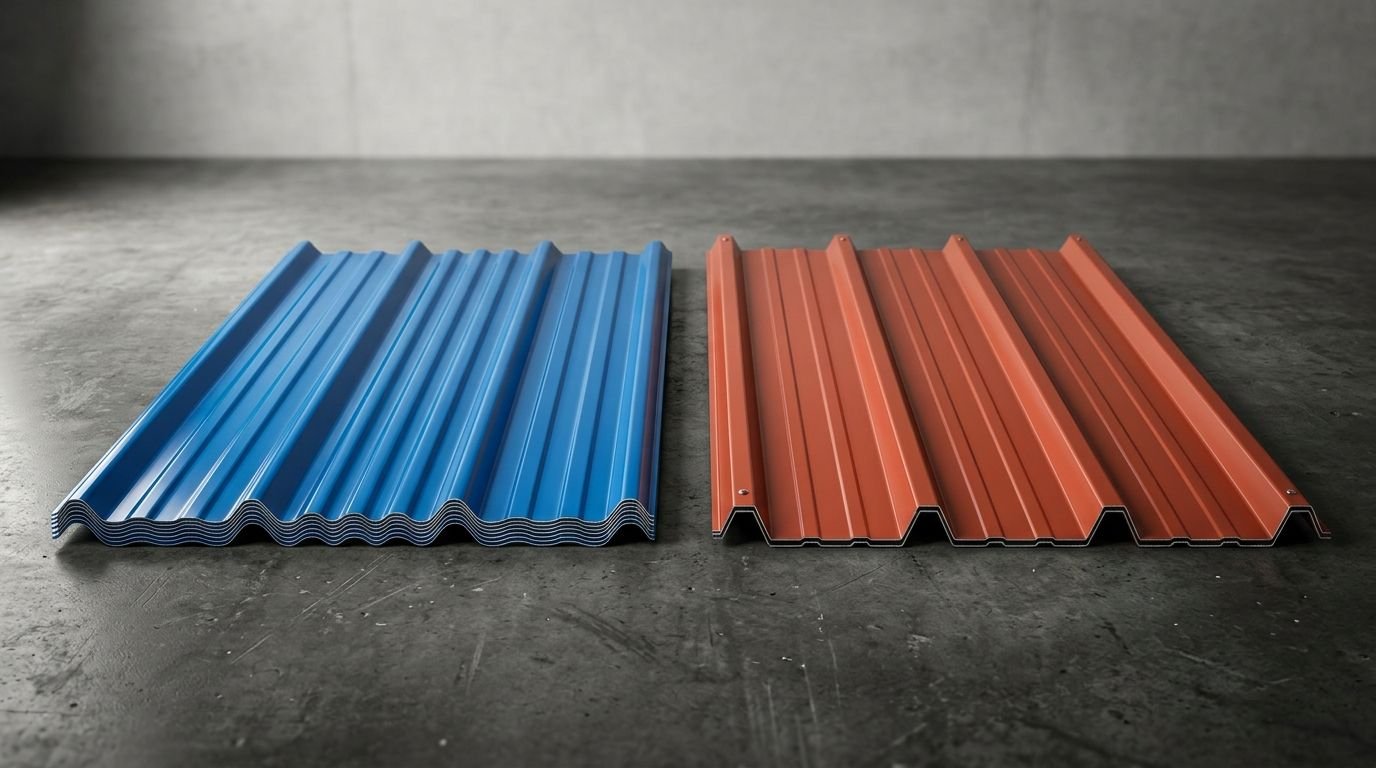
Understanding Gauge & Thickness Standards
When engineering an industrial warehouse or pre-engineered building (PEB), roofing sheets endure the harshest exposure to monsoon winds, thermal expansion, and ambient industrial corrosives. Selecting the appropriate sheet thickness—typically ranging between 0.30mm and 0.50mm Total Coated Thickness (TCT)—directly dictates structural longevity, deflection rates, and thermal insulation efficiency.
Core Thickness Classifications
- 0.30mm - 0.35mm: Engineered for light industrial structures, perimeter canopies, temporary storage godowns, and agricultural shades where purlin spans do not exceed 1.1 meters.
- 0.40mm - 0.45mm: The industry standard for heavy warehouses, manufacturing plants, and logistics hubs. Offers balanced tensile strength with optimal deflection resistance under high wind loads.
- 0.47mm - 0.50mm: High-specification industrial grade engineered for chemical environments, heavy monsoon coastal corridors, and wide purlin spans (up to 1.5 meters).
Purlin Spacing and Deflection Calculations
Under Indian Standard IS:875 (Part 3) wind load guidelines, excessive purlin pitch without commensurate sheet thickness can lead to micro-vibrations, fastener fatigue, and localized water pooling. Greater™ profile sheets utilize high-tensile 550 MPa steel substrates combined with precision cold-formed trapezoidal rib geometry that enhances structural rigidity by up to 28% compared to conventional wavy corrugated sheets.
Key Coating Considerations
Base metal thickness is only half the equation; protective coating mass (Alloy Zincalume/Galvalume AZ70 to AZ150) paired with high-durability polyester (RMP/SMP) coating ensures over 25+ years of maintenance-free service life even in demanding Indian climates.